Painting tips

painting tips
how do I choose the right fairf?
The right paint depends on a number of factors. For example, what material are you painting, are you painting indoors or outdoors, and what level of gloss do you want?
- which material are you painting?
Are you painting on brick, wood, metal...? With a few exceptions, you can paint almost any material (provided you have good preparation and a primer). Just choose the right paint. Wall paints, for example, are unsuitable for finishing wood or metal. So-called lacquers or enamel paints have been specially developed for this purpose. - are you painting indoors or outdoors?
Do not simply interchange indoor and outdoor paints. An indoor paint is formulated to be scratch-resistant and maintainable. An outdoor paint is more flexible and resistant to weather influences (such as wind, rain, and sunlight). - what level of gloss do you want?
The fairf wood & metal paint is available in various gloss levels: matt, satin, or high-gloss. If you want paint that is easy to clean, such as in the kitchen or bathroom, do not choose a matt paint, but one with more gloss.
If the paint has more gloss, it contains more binder. Glossy paint is excellent to clean. A point of attention, however, is that you cannot hide imperfections in the surface as well with glossy paint. Proper preparation of the surface is therefore required. Matt paint hides imperfections well, but is less easy to clean. You can also choose a compromise between high-gloss and matt: satin.
do you have tips for a beautiful final result?
We have listed our tips for 'professional painting' for both painting walls and woodwork.
Read these carefully for a beautiful result.
what are the ideal painting conditions?
Ventilate during and after painting as directed on the label and technical data sheet. Keep children out of the work area. Drying and curing times vary by product and conditions.
how do I prepare the surface for painting?
Whatever you are going to paint, make sure your surface is solid, dry, and clean! Remove all loose parts from the surface, such as loose grout, pieces of plaster, as well as peeling or poorly adhering paint. Moisture is one of the main causes of peeling paint. New surfaces, such as masonry or plaster, contain a lot of moisture and must dry out sufficiently long. They are sufficiently dry if they have a moisture percentage lower than 30% (wood is only sufficiently dry at a moisture percentage lower than 13%). The moisture percentage of the surface can be measured with a moisture meter. Painting walls that are too damp will not yield a durable result. The surface you are going to paint must be free of dust, dirt, grease (for example in a kitchen), and other impurities. Clean soiled surfaces beforehand with suitable products. A tip: aromatic-free white spirit is a very good degreaser!Want to know more about cleaning painted surfaces? Read our blog on cleaning painted surfaces.
how do I know if I need to use a primer?
Wet the wall with a sponge or plant sprayer. If the water absorbs into the wall, the wall is absorbent and 1 coat of primer is required. Does the water absorb slowly into the surface or does it bead up and roll off immediately? Then your wall is not absorbent and priming is not necessary.
what grit sandpaper should I use?
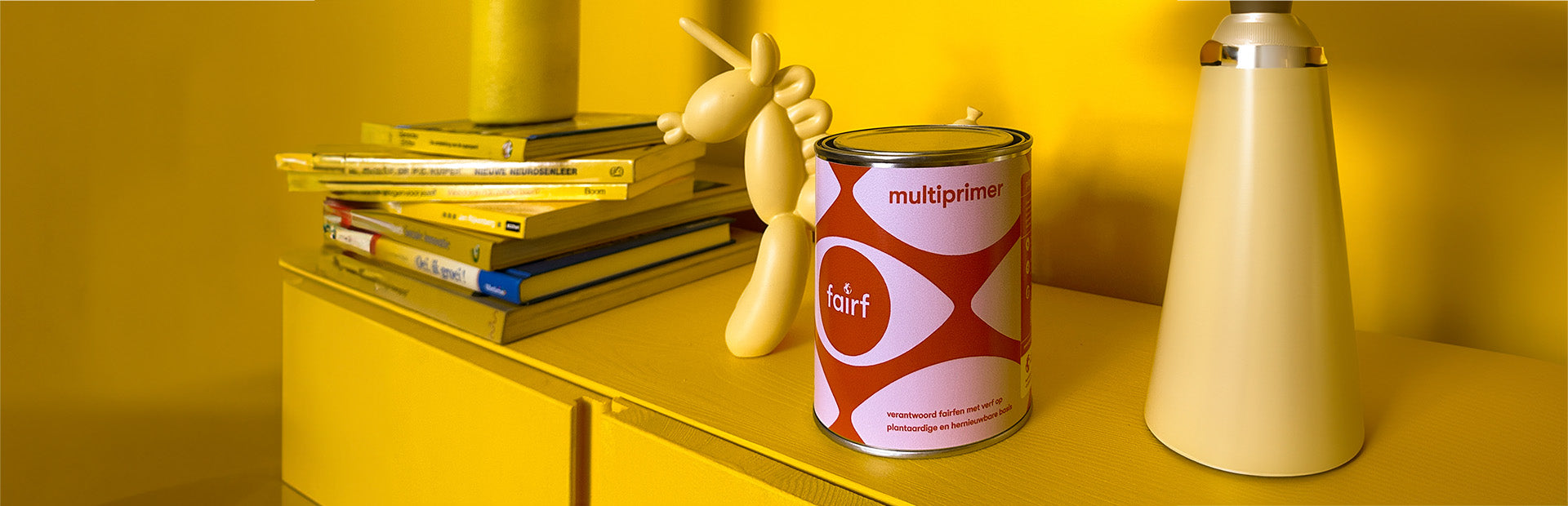
Before you start with woodwork, you must first inspect the surface well. Is the surface not pre-treated? Then we recommend a coat of multiprimer first. Multiprimer ensures good adhesion of our lacquer and therefore a longer lifespan. Are you painting over an existing layer of lacquer? Then sand it with the right grit sandpaper. Always wear safety goggles and a dust mask when sanding.
Here is an overview of different types of sandpaper and their function:
Here is an overview of different types of sandpaper and their function:
- Grit P80 (coarse) for removing and sanding down old paint layers.
- Grit P100 (coarse) for sanding down old paint layers.
- Grit P120 (medium) for sanding down paint layers.
- Grit P150 (medium) for sanding down old paint layers that are still in reasonably good condition.
- Grit P180 (medium/fine) for sanding old paint layers and between new paint layers.
- Grit P220 (fine) for sanding down old paint layers and between layers.
- Grit P240 (fine) for sanding down old paint layers and between layers.
- Grit P320 (very fine) for sanding down and for sanding between new layers.
how much paint do I need if I am going to paint my stairs?
Depending on the number of layers and the size of the stairs, you can determine the amount of paint you need. A standard closed staircase has 13 steps and a surface area of approximately 6m2. Check the paint packaging to see how many m² you can paint with one litre of paint. This way, you can calculate how much paint you need. If you are going to paint the stairs twice, you will need twice as much paint. This also applies to a primer or base coat.how do I create a work of art on the wall with fairf?
On our social media, we sometimes share really cool projects of true works of art created with fairf. Do you also want to create a work of art on your own wall with fairf? Then check out the step-by-step plans we have uploaded with the inspiration projects from the students of Sint Lucas or follow our step-by-step plan.
how do I colour vases with fairf?
- clean the vases thoroughly
- then degrease the vases well with the fairf multicleaner
- open the can of multiprimer and stir well
- apply 1 coat of multiprimer to the vases with a brush
- let it dry thoroughly
- open the can of wood & metal paint and stir well again
- apply the lacquer to the vases with a brush and let it dry thoroughly.
- repeat step 7 until you have the desired colour (intensity) on the vases
- Finished painting? Keep leftover paint tightly sealed and frost-free, following the product instructions, for your next project or a small touch-up. Do not pour paint or rinse water containing paint down the drain. Follow the product label and local collection rules for leftover paint, tool cleaning and empty packaging.
- any leftover fairf can be kept in the can (about 1 year in a frost-free place)
I want to give an old cabinet a second life, is this possible with fairf?
You can actually use fairf very well to give items a second life. Take a look at what you still have in the attic or buy a nice cabinet, table, or bed at the thrift store that you are going to refurbish with fairf. Follow our tips for painting furniture.
What information do I need for toys or children’s furniture?
A beautiful colour is the starting point. Also choose a product suited to the surface and its use. An EN 71-3 test concerns the migration of specified elements under test conditions; it does not automatically make every painted toy suitable or safe. For a specific use on toys or children’s furniture, ask us for product advice and the relevant report. step-by-step plan.do you have tips for painting text on a wall?
Painting text on a wall is precise work for which you need some patience. But it is very fun to do something different with your walls than just a colour, wallpaper, or a painting. Follow the step-by-step plan.is water-based wall paint easy to clean, or will I wipe the paint off?
This does not fundamentally have to do with it being water-based. The water in the paint evaporates from the paint layer during drying. This mainly relates to the scrub resistance class and therefore to the quality of the paint. Our extra matt wall paint has scrub resistance class 1, which is the highest class. It is therefore easy to clean. After painting, it takes 2 to 4 weeks for the scrub resistance, and thus the cleanability, to be reached.
Want to know more about scrub classes? Read our blog about wall paint with scrub class.
Want to know more about scrub classes? Read our blog about wall paint with scrub class.
help, there is a smudge on my wall!
Don't panic, fairf is easy to clean. You can see the smudge well because the paint (often a dark colour) is extra matt, and touching the wall rubs this matt structure closed. Grab a damp cloth that is not too linty. Rub the spot where the smudge is, and you will see that it disappears. It does not matter if some wet streaks get on the wall; these will disappear on their own as the moisture evaporates. Some coloured pigment may remain on your damp cloth—don't panic, this is simply part of it. You don't have to worry about wiping the colour off your wall. Our paint has the highest scrub resistance class 1. Note! Fairf must always cure for at least 4 weeks after application before the scrub resistance class is reached.
Want to know more about scrub classes? Read our blog about wall paint with scrub class.
Want to know more about scrub classes? Read our blog about wall paint with scrub class.
my question is not listed
That can happen, of course, but that doesn't mean we can't help you. Fill out the contact form or send an email directly with your question to info@fairf.nl. We try to answer your question within 1 working day.